
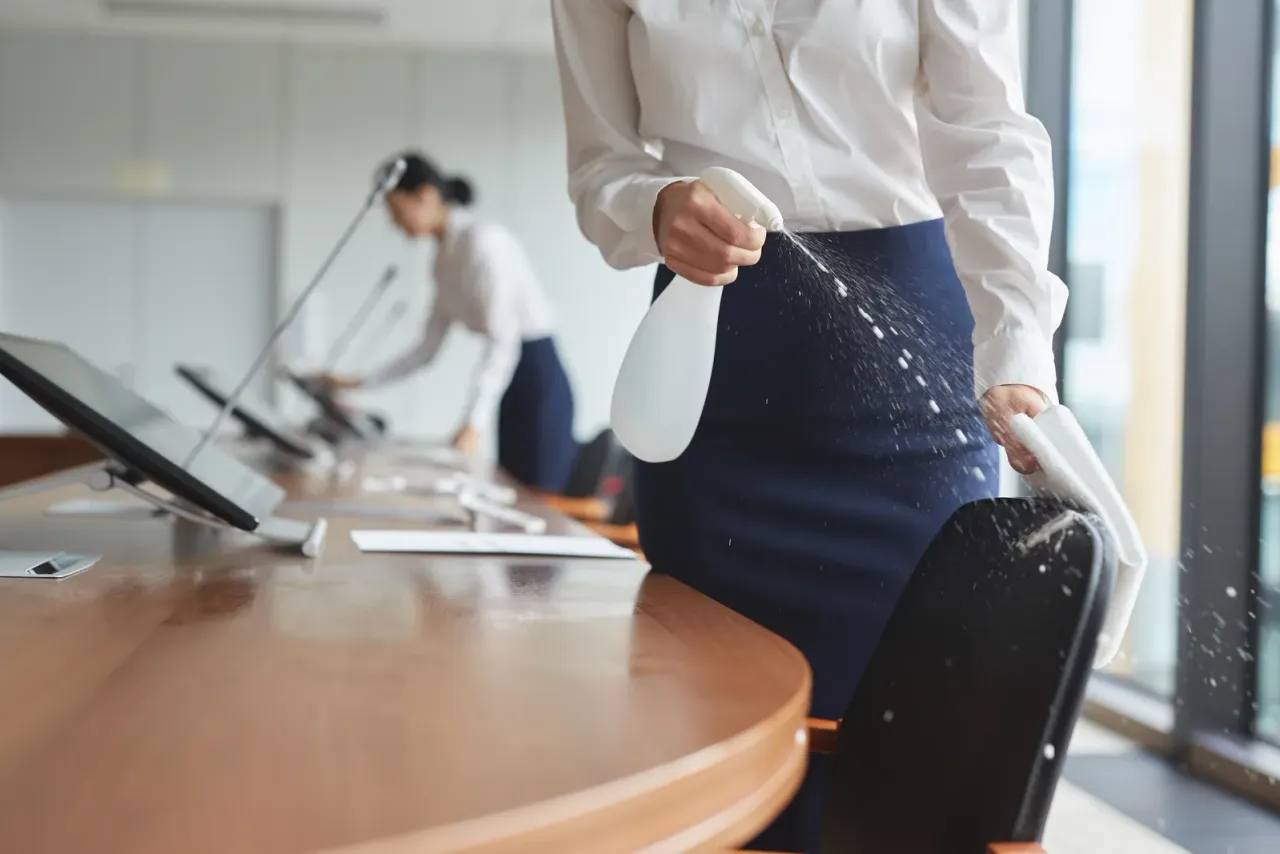
Ontario disinfection
Commercial Disinfection Services in Ontario, CA
Scheduled high-touch disinfection for Ontario facilities, written into the same recurring program that cleans the building, with products used the way their labels require.
The short answer
EBS Maintenance provides commercial disinfection services in Ontario, CA as a scheduled part of a recurring janitorial program, not as a stand-alone spray visit. Crews clean first, then apply EPA-approved disinfectants to restrooms, breakrooms, door hardware and shared equipment, and leave each surface wet for the dwell time on the product label. Frequencies are set per area in a written scope, and field supervisors check and record the work.
Why disinfection belongs inside the cleaning routine
A disinfectant treats the surface as it is at that moment. An hour after a shift change, the time clock, the breakroom refrigerator handle and the restroom door have been touched a few hundred times again. One heavy treatment does little for a building that is used every day; a modest routine repeated on schedule does far more.
That is why EBS writes disinfection into the recurring scope for an Ontario site. The same crew that empties the trash and mops the restroom also carries out the touchpoint round, on the nights and at the times the scope names. Facility managers searching for deep disinfectant commercial cleaning usually need this: a repeatable routine with someone accountable for it.
Touchpoints by building type in Ontario
Ontario's building stock is weighted toward logistics, with retail, hospitality, event, office and medical property around it. The shared surfaces differ in each, so the touchpoint list is written at the walkthrough instead of copied from a template.
| Property type | Surfaces that get the most hands | Usual timing |
|---|---|---|
| Freight and distribution sites | Time clocks, scanner cradles, breakroom tables, vending buttons, locker handles, restroom fixtures | Around shift changes |
| Office suites and business-park buildings | Door hardware, elevator buttons, conference tables, shared printers, kitchen appliances | Each service night |
| Retail near Ontario Mills | Entry doors, payment counters, fitting-room hardware, restroom fixtures | Outside trading hours |
| Hotels and event-district properties | Lobby counters, handrails, elevator panels, public restrooms | Daily, heavier on event days |
| Medical suites | Waiting-room chairs, check-in counters, exam-room surfaces named in the scope | After the last patient |
Clean first, then give the product its dwell time
Disinfectants are tested on clean surfaces. Dust, grease and skin oils shield what sits underneath, and Ontario supplies plenty of grit: truck traffic around the airport and distribution centers, and seasonal Santa Ana winds that push dust through dock doors and entries. So the sequence matters. Crews remove visible soil with a detergent or a cleaner-disinfectant first, then apply the disinfectant.
Dwell time is the second half. Every label states how long the surface must stay visibly wet, often several minutes. In hot, dry inland summers a thin wipe can flash off before that time is up, particularly near open dock doors. Crews are trained to apply enough product, work in small sections and re-wet a surface that dries early.
- EPA-approved disinfectants, matched to the surface material
- Separate cloths for restrooms and food areas
- Food-contact surfaces rinsed where the label calls for it
- Electronics such as scanners and keypads wiped with a method the equipment allows
- Green, non-toxic products available on request for the general cleaning steps
Where fogging and electrostatic spraying fit
Managers often ask about commercial disinfectant fogging services. The practical answer is that a whole-room application does not replace wiping: it does not remove soil, and it reaches only the surfaces the droplets land on. Hand application to named touchpoints remains the core of the program.
EBS can add full-space electrostatic application when a site needs it, for example a large locker room or a training room with many chairs. It is scheduled for clients on a recurring program, in an empty area, with the product's label directions followed for use and re-entry.
How the work is scheduled and verified
Ontario buildings run on every shift, so disinfection can be done in the daytime, in the evening, overnight or on weekends. A round-the-clock distribution center may want a touchpoint round at each shift change, while an office near the Convention Center is covered by the nightly visit.
Supervisors inspect through eHub, EBS's inspection system, which logs what was checked and any corrective action. EBS has one office, in Corona, and sends trained, uniformed, background-checked teams to Ontario from there. To add or change a disinfection routine, ask for a walkthrough at (949) 375-3305.
Last reviewed November 27, 2026 by the EBS Maintenance team.
Questions we hear
Still not sure? A supervisor can answer at the walkthrough.
Request a walkthroughAll questionsCan we book a single disinfection visit for our Ontario building?
No, EBS takes on recurring cleaning programs. Disinfection is written into that program at the frequency each area needs, and heavier applications such as electrostatic spraying are arranged for buildings already on a recurring schedule.
What is the difference between commercial sanitizing services and disinfection?
Sanitizing lowers the number of bacteria on a surface to a level considered safe, while disinfecting destroys a wider range of organisms named on the product label. Food-contact surfaces in a breakroom are usually sanitized. Restroom fixtures and door hardware are disinfected. The scope states which applies where.
How often should high-touch surfaces be disinfected?
It depends on how many people use them. Restrooms and breakrooms in a multi-shift Ontario distribution building may need attention at every shift change, while a single-shift office is normally covered once per service visit. The walkthrough sets a frequency for each area.
Which products do your crews use?
Crews apply EPA-approved disinfection products to the touchpoints listed in the scope. Each product is chosen for the surface, and they follow the label for dilution, contact time and any rinse step. If your site has its own product standard, raise it at the walkthrough.
Will disinfection interrupt our operation?
It should not. Touchpoint rounds are short and are timed for breaks, shift changes or after hours, and any full-room application is scheduled when the area is empty.
Related services and guides
What clients say on Google
Free site walkthrough
Request a walkthrough in Ontario
We take recurring cleaning contracts in Southern California. Tell us where the building is and how often you need cleaning. A supervisor calls you back the same business day.
- Call(949) 375-3305
- Emailinfo@ebsmaintenance.com
- HoursDaytime, evening, overnight and weekend schedules