
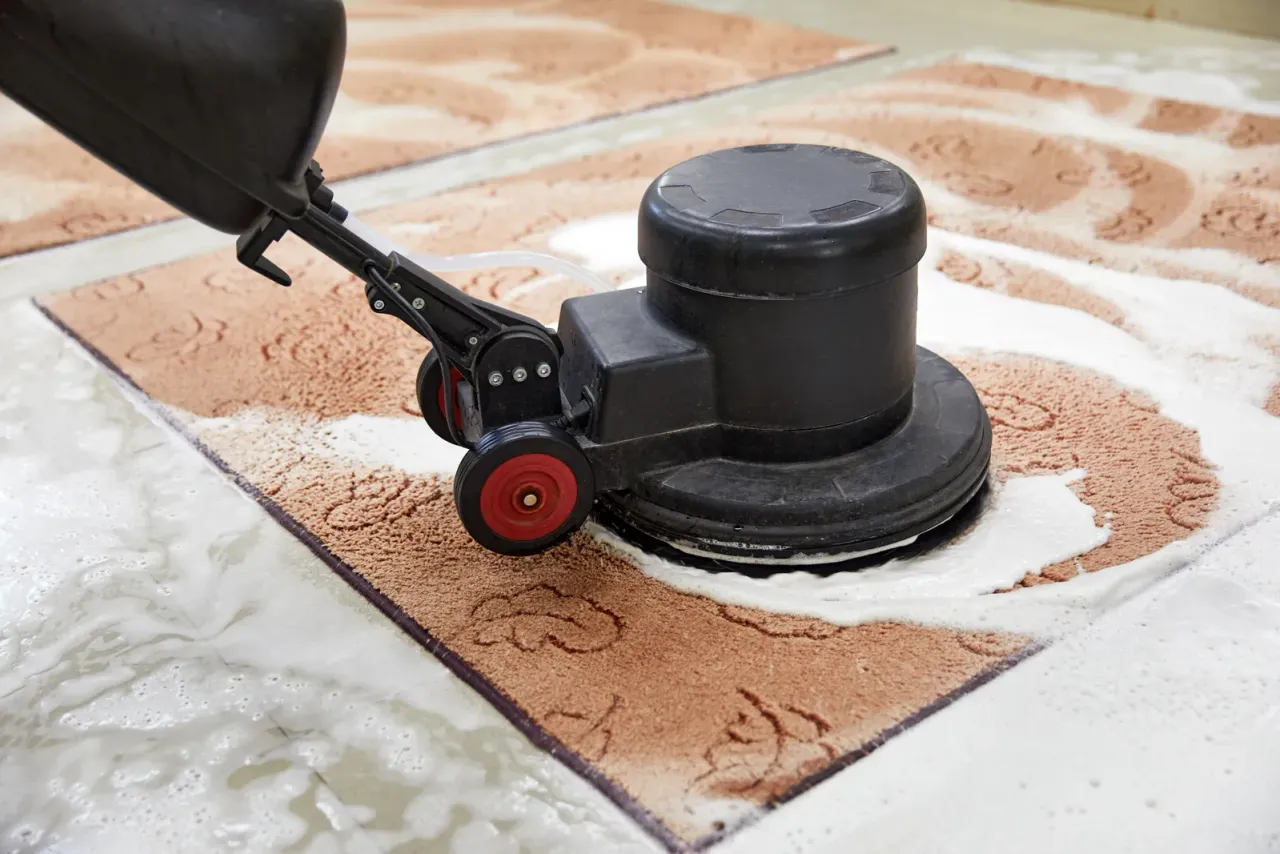
Carpet maintenance programs
Commercial Carpet Maintenance in Southern California
A carpet plan built in four layers and mapped to traffic lanes, run inside a recurring cleaning contract and written down for the facility manager.
The short answer
EBS Maintenance runs commercial carpet maintenance for Southern California facilities as a scheduled program inside a recurring cleaning contract. The program has four layers: soil prevention at entries, daily vacuuming, interim low-moisture cleaning and periodic restorative extraction. Each layer is assigned to zones of the floor plan according to traffic, so a lobby lane and a back office are not cleaned on the same calendar. The plan is put in writing after a walkthrough and is usually provided to clients whose buildings EBS already cleans.
The four layers of a commercial carpet maintenance program
Carpet fails from the bottom up. Dry grit works down to the base of the pile and cuts fiber every time someone walks on it, while oily and sticky soil coats the tips and makes the carpet look gray. Each layer of the program targets one of those problems at the cheapest point to solve it.
| Layer | What it involves | What it prevents |
|---|---|---|
| 1. Soil prevention | Walk-off matting inside and outside entries, vacuumed every visit and cleaned on a cycle; hard-floor entries kept swept | Grit reaching the carpet at all |
| 2. Daily vacuuming | Slow, overlapping passes in traffic lanes every visit; wall-to-wall and edges on rotation; spots treated as found | Dry soil settling to the base of the pile |
| 3. Interim cleaning | Low-moisture methods such as encapsulation in lanes and pivot points, between extractions | Graying lanes and the contrast between used and unused carpet |
| 4. Restorative extraction | Pre-treatment, hot water extraction and assisted drying of whole areas | Embedded soil and residue the first three layers leave behind |
Traffic lanes set the calendar
Square footage tells you how much carpet there is. Traffic tells you how often to clean it. At the walkthrough the floor plan is divided into zones by how many feet cross them: entries, elevator lobbies, main corridors and the paths to restrooms and kitchens at the heavy end; open-office aisles and conference rooms in the middle; private offices and storage at the light end.
Heavy zones get every layer at the shortest interval. Light zones may see interim cleaning rarely and extraction only on the longest cycle. Two spots are watched closely: funnel points, where a wide space narrows to a doorway, and pivot points, where people turn at a copier, a reception desk or an elevator. Those wear first, and they are the first to move up the calendar when an inspection shows them graying early.
Carpet tile and broadloom are handled differently
The four layers apply to both constructions, but the handling changes. Carpet tile has seams everywhere, so moisture is kept low to stop water reaching the adhesive and the subfloor. Its advantage is that a damaged tile can be swapped from spare stock, though a new tile only blends in if the carpet around it has been kept clean.
Broadloom has fewer seams and a continuous backing. Over-wetting it can wick an old spill back to the surface as the carpet dries, which is why a spot can reappear days after extraction. Wet work on broadloom is followed by air movers and a check on the next visit. On either type, furniture goes back on tabs or blocks so legs do not leave rust or dye marks.
What the written plan should contain
A facility manager should be able to read the carpet plan and see who does what, where and when. Expect these items, and ask for any that are missing.
- A zone map marking heavy, medium and light traffic
- The frequency of each layer for each zone
- The method named for interim and for restorative cleaning
- When wet work happens, so areas can be cleared and left to dry
- What your staff move beforehand and what the crew moves
- How spots that do not lift are reported
- How the calendar changes after an inspection
Hard floors and the rest of the cleaning contract
Carpet does not sit apart from the rest of the building. Grit from an unswept tile lobby ends up in the corridor carpet, and finish tracked from a freshly coated breakroom marks the carpet at its edge. That is why commercial floor cleaning maintenance for vinyl, tile and concrete is planned with the carpet calendar, and why EBS usually provides carpet care to clients on a recurring program: the nightly crew is already running layers one and two.
Supervisors check carpet during routine eHub inspections and log corrective actions, so the plan is adjusted from what the floor shows, not from the date alone. Floor technicians and equipment are sent from the Corona office in evening, overnight or weekend slots.
Last reviewed November 20, 2026 by the EBS Maintenance team.
Questions we hear
Still not sure? A supervisor can answer at the walkthrough.
Request a walkthroughAll questionsWhat is encapsulation, and does it replace extraction?
No, it extends the time between extractions. An encapsulating solution is brushed into the pile, surrounds soil as it dries and is removed by later vacuuming. It uses little water and dries fast, which suits traffic lanes, but it does not flush out deep soil the way hot water extraction does.
Does cleaning carpet more often wear it out faster?
The opposite is the usual case. Wear comes mainly from grit cutting fibers underfoot, so removing it regularly protects the pile. Damage from cleaning tends to come from over-wetting, harsh chemistry or residue left behind, which a planned program is designed to avoid.
Can EBS run our carpet program if another company handles the nightly janitorial?
Carpet programs are usually provided to clients on a recurring EBS program. Two of the four layers, entry mat care and daily vacuuming, are nightly janitorial tasks, so splitting them between companies makes results hard to manage.
Should we keep records of carpet cleaning?
Yes. Dates, areas and methods show whether the plan is being followed, and many carpet manufacturers ask for maintenance records under their warranties, so check the terms for your product. EBS documents completed work and inspection results.
How is the cost of a carpet program worked out?
From the walkthrough. The drivers are carpeted square footage, how much of it is heavy traffic, the frequency of each layer, furniture density, access hours and drying constraints. EBS quotes after seeing the building and does not publish a rate.
Related services and guides
Free site walkthrough
Request a walkthrough
We take recurring cleaning contracts in Southern California. Tell us where the building is and how often you need cleaning. A supervisor calls you back the same business day.
- Call(949) 375-3305
- Emailinfo@ebsmaintenance.com
- HoursDaytime, evening, overnight and weekend schedules