
Restaurants
Restaurant Cleaning Services in Southern California
A restaurant is cleaned by three groups: your staff, a janitorial crew and licensed specialists. Knowing where each one starts and stops prevents gaps.
The short answer
Restaurant cleaning services in Southern California usually means a janitorial crew that works after close to clean dining rooms, restrooms, bars, offices, back corridors and floors, while your kitchen staff keep food-contact surfaces and cooking equipment clean and licensed specialists handle hood ducts, grease interceptors and pest control. A good program writes that split down, controls cross-contamination with color-coded tools, keeps grease off walking surfaces, and finishes before the morning prep crew arrives.
What restaurant cleaning services in Southern California cover
Most restaurant janitorial services work the night shift. Once the last guests leave and the closing manager hands over, a crew resets the dining room and bar front, cleans and restocks restrooms, cleans the host stand, offices, employee break and locker areas, and degreases and mops floors. Periodic work such as grout scrubbing, upholstery cleaning, window cleaning and pressure washing of entrances, patios and trash enclosures is scheduled on a calendar.
What a crew does not do matters just as much. Cutting boards, prep tables, slicers, fryers and other food-contact or cooking equipment are your trained staff's work under your food safety procedures. Getting that boundary written into the scope prevents the two most common problems: tasks both sides assume the other is doing, and a crew using the wrong product near food.
Who cleans what in a restaurant
Use this split as a starting point and adjust it to your concept. A fine-dining room with linens and a quick-service counter will move a few lines between columns.
| Area or task | Usually handled by | Notes |
|---|---|---|
| Food-contact surfaces and prep tables | Kitchen staff | Cleaned and sanitized under your food safety procedures |
| Cooking equipment | Kitchen staff | Deep cleaning sometimes by an equipment specialist |
| Hood and exhaust ducts | Licensed hood cleaning contractor | Inspected and cleaned under fire code requirements based on NFPA 96 |
| Grease interceptor or trap | Licensed pumping service | Schedules are often set by the local sewer agency |
| Pest control | Licensed pest control operator | Crews report droppings or activity they see |
| Dining room, bar front, restrooms, glass | Janitorial crew | Nightly, plus periodic deep work |
| Floors throughout, including degreasing | Janitorial crew | Back-of-house floors scoped at the walkthrough |
| Trash enclosure and back door area | Janitorial or exterior crew | Pressure washed on a schedule to control odor and pests |
Color-coded tools keep restroom germs out of the dining room
The fastest way to spread contamination in a restaurant is a cloth or mop that moves from the restroom to the dining room. Professional crews prevent that with color-coded microfiber cloths and mop heads: one color reserved for toilets and urinals, another for other restroom surfaces, another for dining tables and general surfaces, and another for glass. The exact colors vary by company; what matters is a posted chart, consistent use and separate buckets.
Ask any restaurant cleaning company you interview to show its color chart and explain how soiled cloths are bagged and laundered. If the answer is vague, assume the same cloth is doing every job.
Grease, slips and floor care
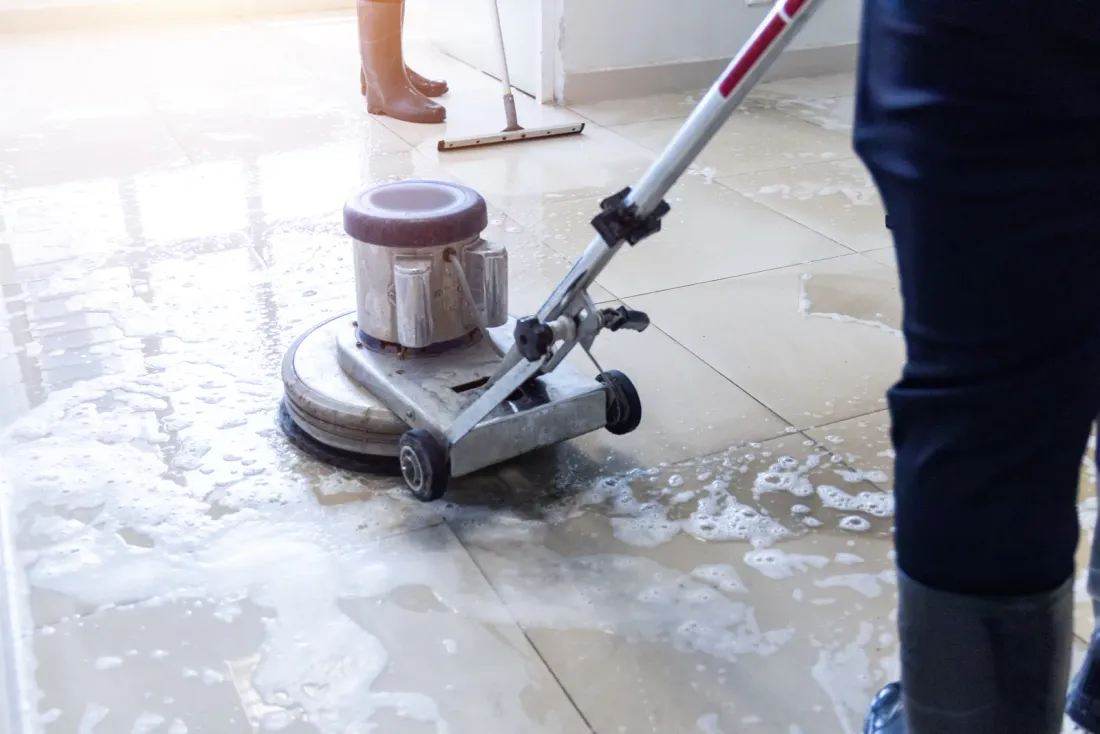
Kitchen grease does not stay in the kitchen. It rides out on shoes into service corridors and dining areas, building a film that dulls finishes and makes floors slippery. Plain mopping spreads it around, especially with mop water that is not changed often. Degreasing needs the right product at the right dilution, enough contact time to break the film, and scrubbing or a machine before the floor is rinsed and dried.
Quarry tile, sealed concrete and the grout between dining room tiles all hold grease differently, so set a periodic machine scrubbing schedule on top of nightly mopping. Keep anti-fatigue and anti-slip mats in kitchen walkways clean as well, since a greasy mat simply moves the hazard.
After-close access and health inspection readiness
Night crews need a predictable handover: a set start time after the closing manager finishes, a named person for keys and alarm codes, and a rule for what happens if service runs late. The crew should finish and lock up before the morning prep team arrives, leaving a short note about anything they found, such as a leaking faucet, a broken tile or signs of pests.
Retail food facilities are inspected by county environmental health departments under the California Retail Food Code, and Los Angeles County posts letter grades in restaurant windows. Food handling and kitchen practices are the restaurant's responsibility, but clean, stocked restrooms, clean floors and a tidy trash area are part of the picture an inspector and every guest sees.
EBS restaurant janitorial services
EBS Maintenance provides after-close janitorial work for hospitality spaces: dining areas, restrooms and floors cleaned to a written scope, high-touch surfaces disinfected with EPA-approved products, and periodic floor care, glass and pressure washing scheduled ahead. Supervisors run eHub inspections and stay in touch with your manager. Hoods, kitchen equipment and food safety stay with your staff and licensed specialists. Teams travel from the Corona office; call (949) 375-3305 for a walkthrough.
Related questions
Still not sure? A supervisor can answer at the walkthrough.
Request a walkthroughAll questionsDo restaurant cleaning companies clean kitchen hoods?
General janitorial companies usually do not. Hood and exhaust duct cleaning is a specialist trade, inspected under fire code requirements, and most restaurants hire a dedicated hood cleaning contractor for it. Make sure your janitorial scope states that hoods are excluded so nobody assumes otherwise.
When should a restaurant be cleaned by an outside crew?
After close, once the kitchen is shut down and the closing manager has finished. That gives the crew empty floors and avoids chemicals near food service. The crew should be done before the morning prep team starts, which sets the length of the cleaning window.
What should a restaurant cleaning contract include?
A zone-by-zone scope, nightly and periodic tasks, which areas are excluded (food-contact equipment, hoods), who supplies chemicals and paper goods, the color-coding system, key and alarm procedures, the cleaning window and how the crew reports maintenance or pest issues.
Keep reading
Free site walkthrough
Talk to EBS about your facility
A few details and a supervisor calls you back the same business day.
- Call(949) 375-3305
- Emailinfo@ebsmaintenance.com
- HoursDaytime, evening, overnight and weekend schedules