
Industry trends
How Technology Is Changing Commercial Cleaning
Software, sensors and new equipment are changing how buildings are cleaned and how results are proven. Some of it is genuinely useful; some is mostly marketing.
The short answer
Technology in commercial cleaning is changing two things: how the work is done and how it is proven. Inspection apps replace clipboards with timestamped, photo-backed records; ATP meters give a number for surface residue; battery-powered and robotic floor machines cover large floors with less labor; electrostatic sprayers coat complex areas evenly; and sensors let restrooms be serviced by use rather than by the clock. None of it replaces trained people, but used well it makes cleaning more consistent and easier to verify.
Commercial cleaning technology at a glance
Most new tools fall into four groups: tools that record and verify the work, tools that measure cleanliness, equipment that does the physical work faster or better, and sensors that tell crews where they are needed. Each has a sweet spot and a limit.
| Technology | What it does well | Limits to know |
|---|---|---|
| Inspection and work-order apps | Timestamped scores, photos and follow-up by area | Only as honest as the person inspecting |
| ATP meters | Quick reading of organic residue on a surface | Does not identify germs; readings vary by brand |
| Autonomous floor scrubbers | Consistent scrubbing of large open floors | Need setup, mapping and people for edges and corners |
| Battery and lithium-ion equipment | Quieter, cordless work suited to daytime cleaning | Charging schedules and battery replacement |
| Electrostatic sprayers | Even disinfectant coverage on complex surfaces | Do not remove soil; touchpoints still need wiping |
| Chemical dispensing systems | Accurate dilution every time | Must be maintained and checked |
| Occupancy and dispenser sensors | Service triggered by actual use | Installation, connectivity and someone to act on alerts |
Inspection apps: the most useful technology in commercial cleaning
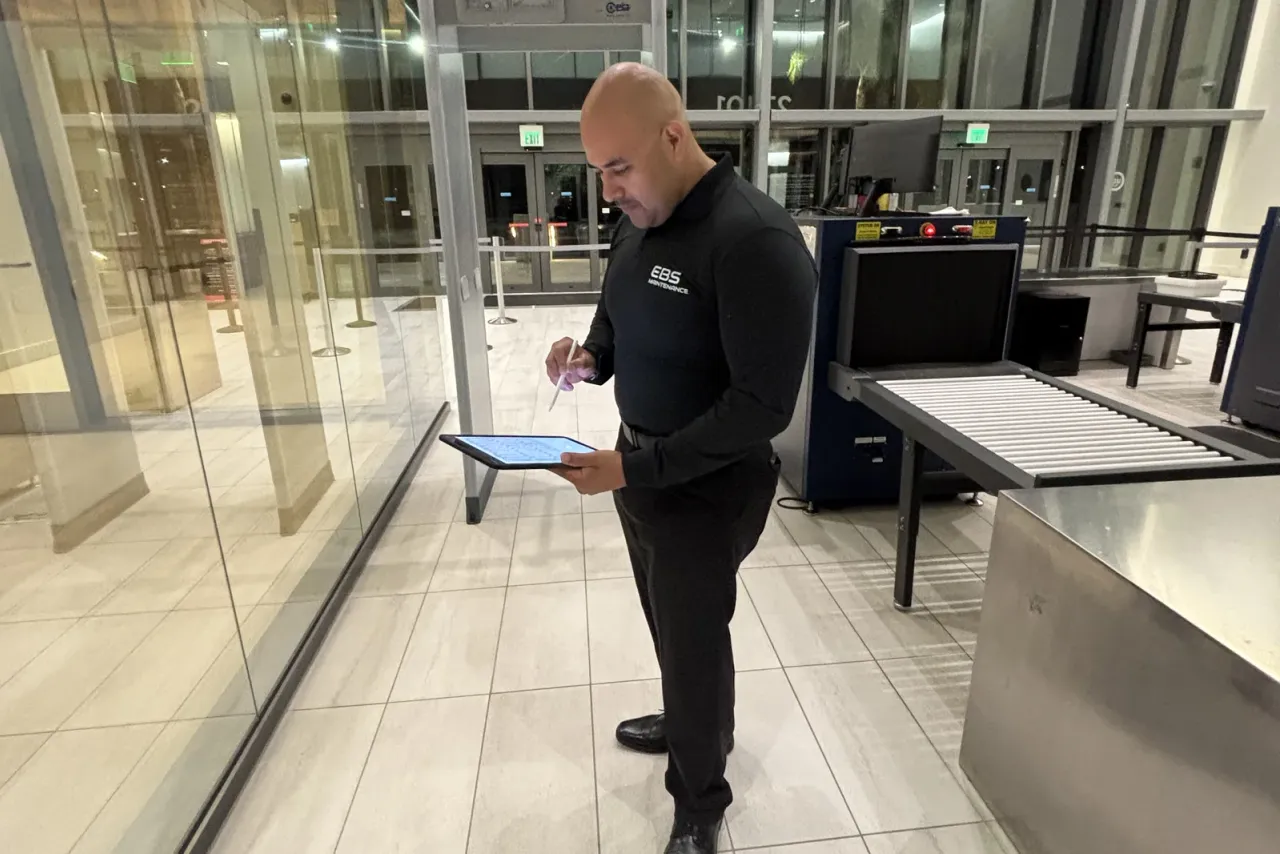
The biggest practical change is in quality control. Paper checklists get filled in at the end of a shift from memory, and nobody looks at them again. Inspection software records who inspected which room, when, what score it received and what was wrong, often with photos, and it keeps a corrective action open until someone closes it.
For a facility manager, that turns cleaning quality from an impression into a trend. You can see whether one restroom fails every week, whether scores drop on a particular night, and whether problems raised last month were actually fixed. The limit is human: software records what an inspector checks, so it still needs supervisors who inspect honestly and often.
Measuring and disinfecting: ATP testing and electrostatic sprayers
ATP testing swabs a surface and uses a handheld meter to measure adenosine triphosphate, a molecule found in organic matter. A high reading means organic residue was left behind. It is a useful training and spot-check tool, common in food service and healthcare, but it does not identify specific germs, and results from different manufacturers' meters are not directly comparable, so set pass levels for the system you use.
Electrostatic sprayers give disinfectant droplets a charge so they spread over and wrap around surfaces, which helps in rooms with many complex surfaces such as classrooms, gyms and transit seating. They work only with products whose labels allow that application, and they never replace cleaning: the surface still needs soil removed first.
Machines that change the physical work
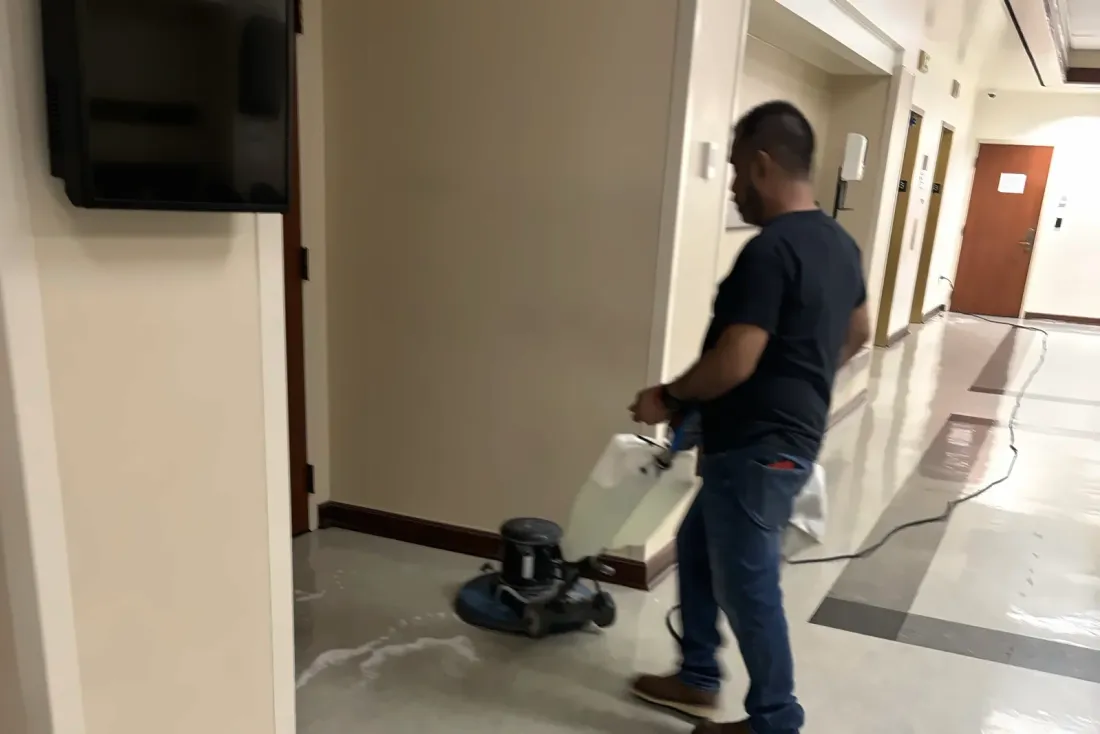
Autonomous floor scrubbers are now common in large retail stores, airports and warehouses. Once a route is mapped, the machine scrubs open floor consistently while the operator handles edges, corners, spills and the tasks a robot cannot do. They suit big, uncluttered floors far better than offices full of chairs and cables.
Less visible changes matter as much. Cordless battery equipment is quieter, which makes daytime cleaning practical in occupied buildings. Backpack and upright vacuums with HEPA filtration capture fine dust instead of blowing it back into the room. Microfiber flat-mop and cloth systems use less water and chemical than string mops and cotton rags, and dispensing systems mix concentrates to the label dilution so crews are not guessing.
Modern commercial cleaning by demand, not the clock
Traditional schedules clean every restroom at fixed times whether ten people used it or two hundred. People counters, smart dispensers and occupancy data from badge systems let crews go where use has actually been heavy, which matters in hybrid offices and buildings with uneven traffic. QR codes posted in restrooms give occupants a direct way to report a problem.
Before investing, ask practical questions of any vendor proposing this kind of system:
- Who installs and maintains the sensors, and who pays for them?
- What happens to the data, and does it raise any privacy concern for occupants?
- Who receives alerts after hours, and how fast can they realistically act?
- How will the schedule change, and how will you know it is working?
How EBS uses technology on its programs
EBS Maintenance runs quality control through eHub inspections, which record what supervisors checked, what needs attention and each corrective action through to completion. Programs use HEPA-filtered vacuums, EPA-approved disinfectants and electrostatic application where the space calls for it, alongside trained, uniformed crews. Southern California sites are served from the Corona office. Ask about it at your walkthrough by calling (949) 375-3305.
Related questions
Still not sure? A supervisor can answer at the walkthrough.
Request a walkthroughAll questionsWill cleaning robots replace janitors?
Not in most buildings. Robotic scrubbers handle large open floors well, but restrooms, desks, kitchens, stairs, spills and the many small judgments a cleaner makes each night still need people. In practice, robots shift staff time from repetitive floor passes to detail work.
Is electrostatic spraying better than wiping surfaces?
It is better at coverage, not at cleaning. Spraying reaches the sides and undersides of complex objects evenly, but it does not remove dirt. Touchpoints should be cleaned first, then disinfected by wiping, spraying or both, following the product label.
Does new cleaning technology raise the price of service?
Sometimes, and sometimes it lowers labor time enough to offset the cost. Robotic scrubbers and sensor systems carry equipment costs, while microfiber and dispensing systems often reduce product use. Ask vendors to explain what each tool changes in the scope rather than paying for technology on its own.
Keep reading
Free site walkthrough
Talk to EBS about your facility
A few details and a supervisor calls you back the same business day.
- Call(949) 375-3305
- Emailinfo@ebsmaintenance.com
- HoursDaytime, evening, overnight and weekend schedules