
Label contact time
What Is Disinfectant Dwell Time and Why Does It Matter?
Most disinfection failures are timing failures. The chemistry works only if the surface stays wet long enough, and many cleaning routines never give it the chance.
The short answer
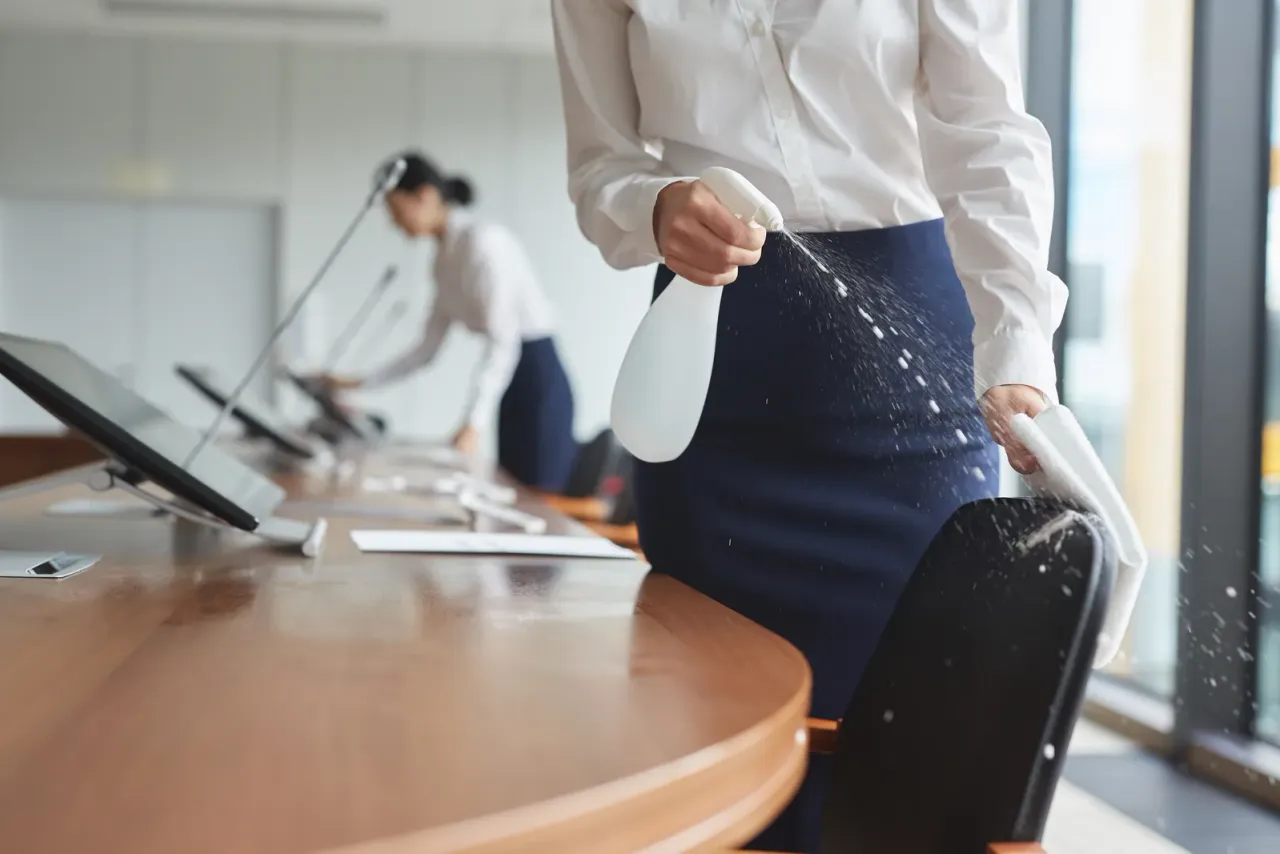
Disinfectant dwell time, called contact time on EPA labels, is how long a surface must stay visibly wet with the product to kill the organisms the label lists. It commonly ranges from under a minute to 10 minutes, depending on the product and the organism, and if the surface dries early, the label's kill claim no longer applies. That is why spraying and wiping straight away often leaves a surface looking clean without disinfecting it.
Where to find the contact time on a label
Look in the Directions for Use, usually on the back panel, rather than the marketing claims on the front. Many labels list several times: a short one for common bacteria and longer ones for tougher organisms such as norovirus or Clostridioides difficile spores. The time that applies is the one for the organism you are trying to kill, and when in doubt, the longest listed time is the safe choice.
EPA's guidance is direct: the surface should stay visibly wet for the entire contact time, and if it dries early, more product should be applied. The label is part of the product's federal registration, so using a product in a way that departs from its directions is a misuse, not a shortcut.
Why spray-and-wipe fails
The most common routine in commercial cleaning, a quick spray followed by an immediate wipe, removes the product before it has had time to work. Several other habits cut contact time short or weaken the solution.
- Wiping right away instead of letting the surface stand wet
- Using too little product to keep a large surface wet
- Skipping pre-cleaning, so soil shields microbes; only products labeled as one-step cleaner-disinfectants may skip it, and only on lightly soiled surfaces as the label allows
- Diluting by eye instead of with a dispenser, producing a weaker solution than the label requires
- Using cotton rags with quaternary ammonium products, which can absorb the active ingredient and lower its strength
- Spraying vertical surfaces where the product runs off before the time is up
How dry air and airflow shorten disinfectant dwell time
Evaporation is the hidden variable. A contact time proven under laboratory conditions can be hard to meet on a warm, dry day in an inland building, or under a supply air diffuser blowing across a reception counter. Low humidity during Santa Ana wind events, and in desert buildings in the Coachella Valley, speeds drying further.
Crews compensate by applying enough product to stay wet, reapplying when a surface starts to dry, and choosing formats that hold moisture, such as properly saturated wipes or a microfiber cloth charged from a bucket rather than a light mist. Some products are formulated with shorter contact times, which helps in fast-drying conditions as long as the shorter time covers the organisms of concern.
Matching the application method to the surface
The method should follow the label. A product approved only for wiping should not go into a sprayer, and electrostatic application has to appear in the directions before a product can be used that way.
| Method | Suited to | Watch for |
|---|---|---|
| Pre-saturated wipes | Door handles, rails, touchscreens and small high-touch points | Wipes drying out, or one wipe stretched over too large an area |
| Trigger spray, then stand | Counters, tables and restroom fixtures | Overspray, and runoff on vertical surfaces |
| Microfiber charged from a bucket | Restroom partitions and large horizontal surfaces | Changing cloths and solution often enough; compatibility with quats |
| Electrostatic sprayer | Large rooms and irregular surfaces | Product must be labeled for electrostatic use; surfaces still need cleaning first |
How to check that your vendor respects contact time
None of these checks takes long, and together they show whether disinfection is happening or only smells like it is.
- Ask for the product name and EPA Registration Number of each disinfectant
- Ask which contact time the crew follows and which organisms it covers
- Read the written procedure: clean, apply, wait the full time, then wipe or air-dry as the label says
- Watch a crew member disinfect a restroom and time it
- Confirm dilution comes from a metered dispenser, and ask how long diluted solution is kept
- Use ATP testing if you want a number, remembering it measures organic residue, not disinfection
How EBS applies disinfectants
EBS disinfects door handles, rails, desks, restrooms and shared equipment with EPA-approved products, either on a recurring schedule or on call, and the products and areas are set in the scope at the walkthrough. Supervisors check disinfection work during routine inspections and log corrective actions in eHub. Green, non-toxic and biodegradable cleaning products are available on request, with disinfectant choices made around the organisms each site is concerned about.
Related questions
Still not sure? A supervisor can answer at the walkthrough.
Request a walkthroughAll questionsIs dwell time the same as contact time?
Yes. Dwell time is the industry term and contact time is the term EPA labels use; both mean how long the surface must stay wet for the label's claims to apply. Some product literature calls it kill time.
Do sanitizers have contact times too?
Yes. Sanitizers reduce bacteria to safer levels rather than killing everything a disinfectant claims, and their labels carry their own contact times, often shorter. Food-contact sanitizers also set a use concentration and say whether a rinse is needed, so read those directions separately.
Should the surface be wiped dry after the contact time?
Follow the label. Many products allow air-drying or wiping once the contact time is met, while some require a potable water rinse on food-contact surfaces. Wiping early is the mistake; wiping after the full time is usually fine.
Can a stronger mix shorten the contact time?
No. Using more concentrate than the label specifies does not shorten the required time, departs from the label directions and leaves residue that attracts soil and can irritate skin. Accurate dilution through a dispenser is the better route.
Do disinfectant wipes have a contact time?
Yes, and it is printed on the canister. The wipe has to leave enough liquid to keep the surface visibly wet for that time, so larger areas need more than one wipe, and a wipe that has started to dry should be replaced.
Keep reading
Free site walkthrough
Talk to EBS about your facility
A few details and a supervisor calls you back the same business day.
- Call(949) 375-3305
- Emailinfo@ebsmaintenance.com
- HoursDaytime, evening, overnight and weekend schedules