
Pricing explained
Commercial Cleaning Costs: What Drives the Price
No honest vendor can price a building from a phone call. Here is what a cleaning quote is made of, so you can read one, compare several and see where the money goes.

The short answer
Commercial cleaning costs are driven mainly by the labor hours a building needs, and those hours come from cleanable square footage, how often each area is cleaned, the task list, the number of restrooms, floor types, traffic, the schedule and any security or specialized-area rules. Vendors express the result per square foot, per hour or as a flat monthly price, but the hours underneath are what you are actually buying.
The four ways cleaning is priced
Most quotes use one of four formats. They are different ways of packaging the same estimate of hours, supplies and overhead, so the format matters less than whether you can see the assumptions behind it. Ask every bidder for the weekly on-site hours their price assumes, whichever format they use.
| Model | How it works | Suits | Watch for |
|---|---|---|---|
| Per square foot | A rate applied to cleanable area, billed monthly | Stable recurring programs in larger buildings | Whether the rate uses gross or cleanable area |
| Hourly | A rate per labor hour on site | Day porters, variable or on-call work | How hours are verified |
| Flat monthly | One fixed price for a written scope | Small and mid-size recurring accounts | A vague scope behind a simple number |
| Per project | A quote for one defined job | Floor restoration, post-construction, move-outs | What is excluded and who supplies access |
What drives commercial cleaning costs
Each factor below either adds hours, adds skill or adds overhead. Two buildings of the same size can be priced very differently once these are counted, which is why a rate quoted for a colleague's property, or found in an online calculator, rarely transfers to yours.
| Factor | Why it changes the price |
|---|---|
| Cleanable square footage | More area means more hours, though not in a straight line |
| Frequency | Nightly service costs more than three nights a week, area by area |
| Scope and task list | Detail work such as high dusting or desk wiping adds time |
| Restrooms and fixtures | Restrooms take far longer per square foot than open offices |
| Floor types | Carpet, resilient tile, stone and concrete each need different time and equipment |
| Occupancy and traffic | More people means more trash, soil and restocking |
| Schedule | Night, weekend and split shifts change staffing and supervision |
| Security and access | Escorts, badging and background screening add time and administration |
| Specialized areas | Clinical rooms, labs and cleanrooms need trained staff and protocols |
| Supplies | Including paper, soap and liners raises the monthly figure |
| Local wage rates | California and several of its cities set minimum wages that are adjusted every year |
Cost per square foot, explained
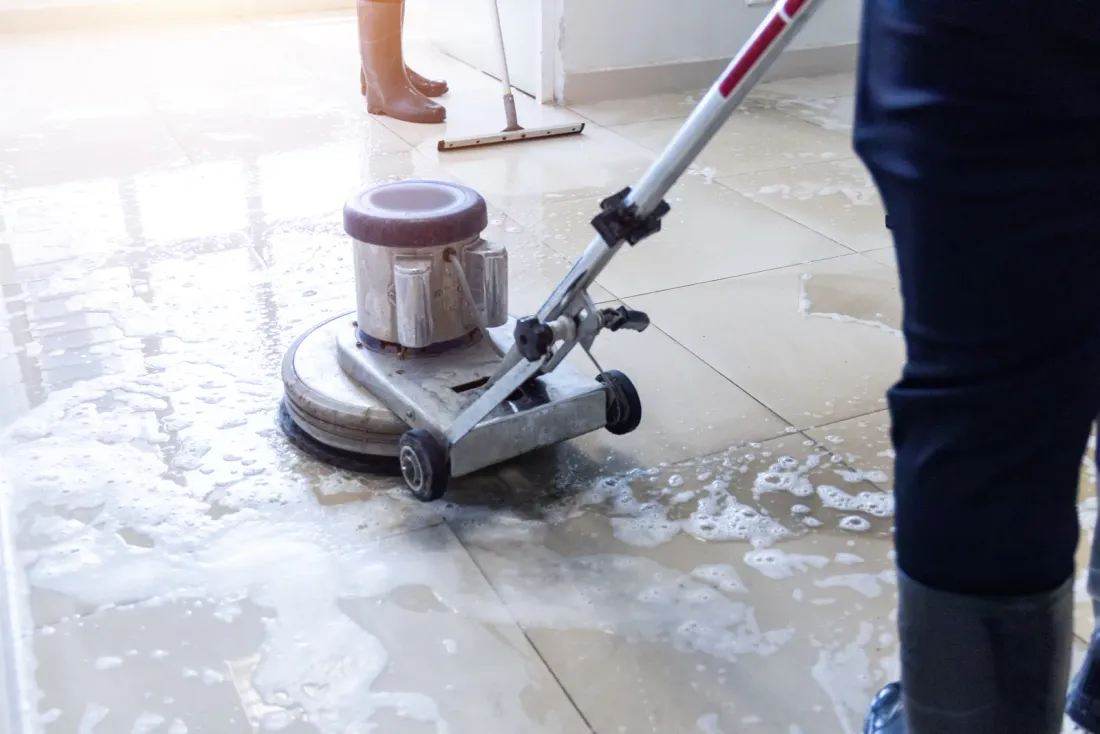
A per-square-foot rate is convenient because it scales and compares easily, but it hides the mix of spaces inside the number. A building with many restrooms, a busy lobby and a cafe will cost more per foot than an open-plan office of the same size, because restrooms and food areas absorb far more time per foot than workstations do. Warehouses tend to run the other way: large open floors cleaned by ride-on machines.
Before comparing rates, make sure every bidder used the same area. Cleanable square footage leaves out spaces the crew never touches, such as mechanical rooms, shafts and some storage, so a rate on gross area and one on cleanable area are not comparable. The clearest bids state both the area and the hours they assume.
Costs that sit outside the monthly price
Monthly prices usually cover recurring work only. Budget separately for the items that come up on a cycle or on demand, and ask each vendor how it prices them before you sign, so the first invoice for project work is not a surprise.
- Floor stripping and refinishing, scrubbing and recoating, stone care
- Carpet extraction and upholstery cleaning
- Interior and exterior window cleaning
- A start-up deep clean when a new vendor takes over
- Consumables, if they are not in the base price
- Extra visits for events, moves, holidays or emergencies
- Added day porter hours during peak seasons
How a walkthrough turns into a quote
A credible quote starts on site. The estimator walks every area, confirms cleanable square footage, counts restrooms and fixtures, notes floor types and finishes, and learns the building's hours, traffic and access rules. Each area is then assigned tasks and frequencies, and hours are estimated from the time those tasks take in that type of space. Supervision, equipment, supplies, insurance and overhead are added, and the result is presented as a written scope, a schedule and a price.
EBS Maintenance works exactly this way: a supervisor's walkthrough, then a scope, schedule and customized estimate for the building, with no charge for the walkthrough or the estimate. EBS does not publish a price list because two buildings rarely need the same hours.
Related questions
Still not sure? A supervisor can answer at the walkthrough.
Request a walkthroughAll questionsWhy do cleaning quotes for the same building vary so much?
Because each vendor assumes different hours. One may price nightly service where another priced three nights, one may include supplies, and one may have budgeted for a supervisor while another left supervision out. Ask every bidder to state weekly hours, frequencies by area and what is excluded, and the spread usually makes sense.
Is per-square-foot or hourly pricing better?
Neither is better in general. Per-square-foot or flat monthly pricing suits a stable recurring scope, because it rewards the vendor for working efficiently. Hourly pricing suits day porters and work whose volume changes. In both cases, what protects you is a written scope and a way to verify the hours.
Does cleaning at night cost more than cleaning during the day?
Not necessarily. Night crews often work faster in an empty building, while day cleaning has to work around people and may need quieter equipment. Costs rise when the schedule requires escorts, split shifts or weekend work. The right schedule is the one that fits how the building is used.
Can cleaning prices change during a contract?
Yes, usually for three reasons: wage increases required by law, changes to the scope or square footage, and changes in occupancy. A good contract explains how each is handled, including how much notice is given, so increases are predictable rather than negotiated in a hurry.
Keep reading
Free site walkthrough
Talk to EBS about your facility
A few details and a supervisor calls you back the same business day.
- Call(949) 375-3305
- Emailinfo@ebsmaintenance.com
- HoursDaytime, evening, overnight and weekend schedules