
Screening cleaning staff
How Are Janitors Background-Checked for Secure Facilities?
A single criminal record search is the floor, not the standard. Secure sites stack several checks, and California law shapes how each one may be run.

The short answer
A janitor background check for a secure facility is usually layered: identity and work-authorization verification, a criminal history search run within California's fair chance and consumer reporting rules, and then whatever the site itself requires, such as fingerprint-based checks, a federal credential investigation, or an airport or seaport security threat assessment. The strongest programs also re-screen on a schedule, keep unscreened people off the site until results return, and tie badge access to each person's screening status.
Layers of a janitor background check for a secure facility
Each layer answers a different question: is this person who they say they are, are they allowed to work, is there a relevant record, and has the site's own authority cleared them. Buyers can require any combination, but the employer must run each check through the channel the law allows.
| Layer | What it covers | Rules that shape it |
|---|---|---|
| Identity and work authorization | Form I-9 for every hire; E-Verify where used | California Labor Code section 2814 allows E-Verify only after a job offer, unless federal law requires otherwise |
| Criminal history search | County, state and federal court records through a screening company | Federal Fair Credit Reporting Act, California's Investigative Consumer Reporting Agencies Act and Fair Chance Act |
| Fingerprint-based checks | California DOJ and FBI records through Live Scan | Only where a statute authorizes it, such as Education Code section 45125.1 for school contractors |
| Federal credential | Background investigation for a PIV card under HSPD-12 | Run by the federal agency, not the employer |
| Transportation security | TWIC for port secure areas; airport security badges | TSA rules in 49 CFR part 1572 and 49 CFR 1542.209 |
| Drug testing | Pre-assignment or random testing under a written policy | Government Code section 12954 limits testing for off-duty cannabis use |
California rules that govern how screening is done
The Fair Chance Act, Government Code section 12952, bars employers with five or more employees from asking about conviction history before a conditional offer. If a record turns up, the employer must make an individualized assessment of the offense, the time passed and the job, send a preliminary notice, and give the applicant at least five business days to respond before a final decision. The City of Los Angeles and unincorporated Los Angeles County add their own fair chance ordinances.
Reporting limits apply too. California's Investigative Consumer Reporting Agencies Act generally bars screening companies from reporting convictions more than seven years old, and Labor Code section 432.7 restricts using arrests that did not lead to conviction. Federal law requires a written disclosure and the applicant's authorization before any report is ordered.
Checks the site itself can require
Many secure facilities add their own screening on top of the employer's. Federal buildings require an agency investigation before issuing a PIV credential. School districts must have contractors' employees who may contact pupils fingerprinted through the California Department of Justice. Workers who need unescorted access to secure areas of regulated port facilities need a Transportation Worker Identification Credential, and airport badges for secure areas involve a fingerprint-based criminal history check.
Cannabis testing has a specific exception. Government Code section 12954 limits penalizing workers for off-duty cannabis use, but it does not apply to positions that require a federal background investigation or security clearance.
Re-screening and the gaps between checks
A check is a snapshot, so secure sites set rules for what happens afterward. Common requirements include re-running checks at a fixed interval or at contract renewal, renewing site credentials before they lapse, and suspending a badge while a new check is pending. The gap most often missed is coverage: substitute and backup cleaners must be screened to the same standard before they are needed, or a sick call turns into an unscreened person in a secure area. Departures matter as much as arrivals: when someone leaves the contract, their badge, keys and codes should be shut off the same day.
Questions to ask a cleaning vendor about screening
Ask for answers in writing, and make the important ones contract terms rather than sales promises. A vendor that screens properly can describe its process in detail, name the screening company it uses, and explain how it handles a record that turns up after a conditional offer.
- Which checks are run on every hire, and through which screening company?
- How are California fair chance and reporting rules followed?
- Are backup and substitute staff screened to the same level?
- How often are checks repeated, and what triggers an early re-check?
- Can the vendor support site-required checks such as fingerprinting or agency investigations?
- How quickly are access credentials deactivated when someone leaves?
Screening and assignment at EBS
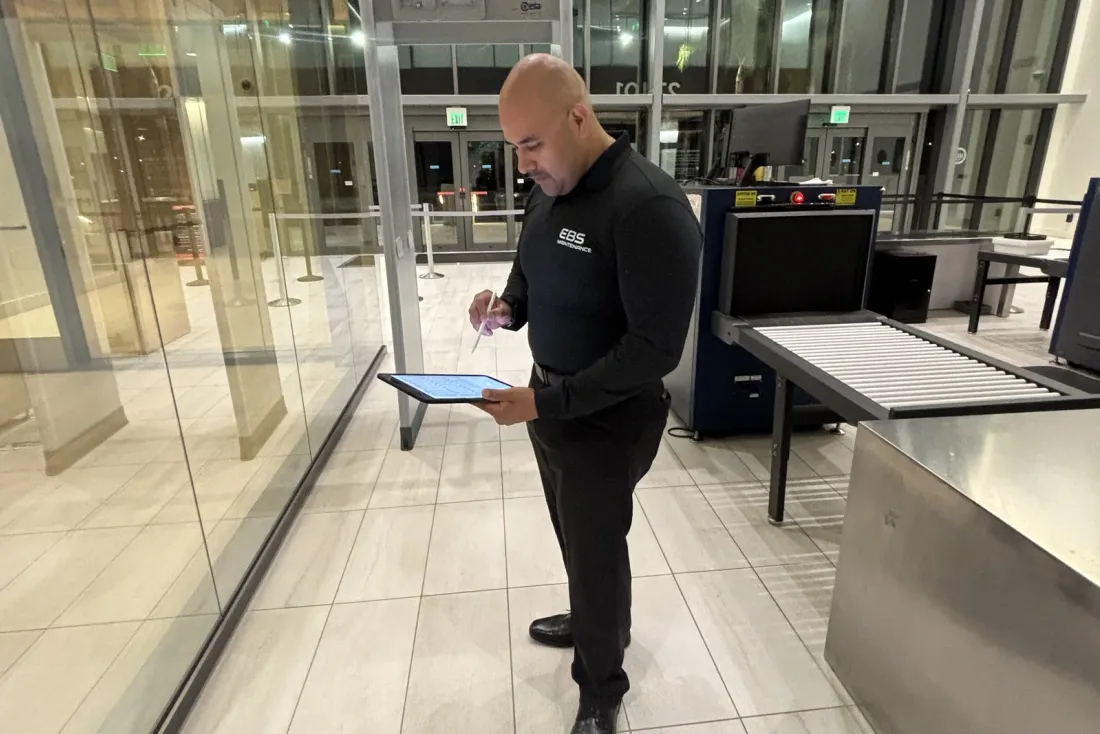
EBS team members are vetted and background-checked, then trained and uniformed before they are assigned to a facility. EBS has worked in high-security and access-controlled environments, including government and secure-facility operations, where confidentiality and accountability are part of the job. Any screening your site adds is set out at the walkthrough, and backup staffing is planned around the same requirements.
Related questions
Still not sure? A supervisor can answer at the walkthrough.
Request a walkthroughAll questionsCan a cleaning company refuse to hire someone with a criminal record?
Only after following California's process, unless another law requires the exclusion. Under the Fair Chance Act the employer must wait until after a conditional offer, assess the specific conviction against the job, and give notice and a chance to respond. Some site rules, such as school or airport requirements, set their own disqualifying offenses.
How far back does a background check go in California?
For reports from screening companies, generally seven years for convictions under California's Investigative Consumer Reporting Agencies Act. Fingerprint-based checks authorized by statute can return older records, and federal investigations follow their own rules. The employer also has to consider how long ago an offense was in its individualized assessment.
Can our facility run its own checks on contract cleaners?
Yes, through a lawful channel and with each person's authorization. Many sites ask the contractor to run checks to a written standard and certify the results, while agencies and airports run their own investigations directly. Live Scan fingerprinting is only available where a statute authorizes it.
Are temporary and backup cleaners checked too?
They should be, to the same standard as the regular crew. In secure facilities the contract should require it explicitly, because backup coverage is exactly when an unscreened person is most likely to be sent in a hurry.
Keep reading
Free site walkthrough
Talk to EBS about your facility
A few details and a supervisor calls you back the same business day.
- Call(949) 375-3305
- Emailinfo@ebsmaintenance.com
- HoursDaytime, evening, overnight and weekend schedules